Introduction: The Day a Name Almost Defined a Life
Pastor Elijah Osei was born in a small village in Ghana. His mother, after a painful 36-hour labor, looked at her son and whispered, “You have brought me nothing but suffering.” Those words followed him for twenty years. He struggled in school. Relationships failed. Doors closed before he could knock.
Then one Sunday, he stumbled on two verses buried deep inside a biblical genealogy — 1 Chronicles 4:9-10. He read about a man named Jabez, which literally means “born in pain.” A man whose own mother marked him for sorrow before he could speak a word.
Jabez prayed. God answered. Everything changed.
Pastor Osei began praying the same four-sentence prayer. Within three years, he had planted six churches across three countries. “That prayer,” he says, “didn’t give me a formula. It gave me a relationship.”
This is the Prayer of Jabez — and this article will show you exactly what it means, why it works, and how to pray it in a way that honors God and transforms your life.
What Is the Prayer of Jabez?
The Prayer of Jabez comes from 1 Chronicles 4:9-10 in the Old Testament. It reads:
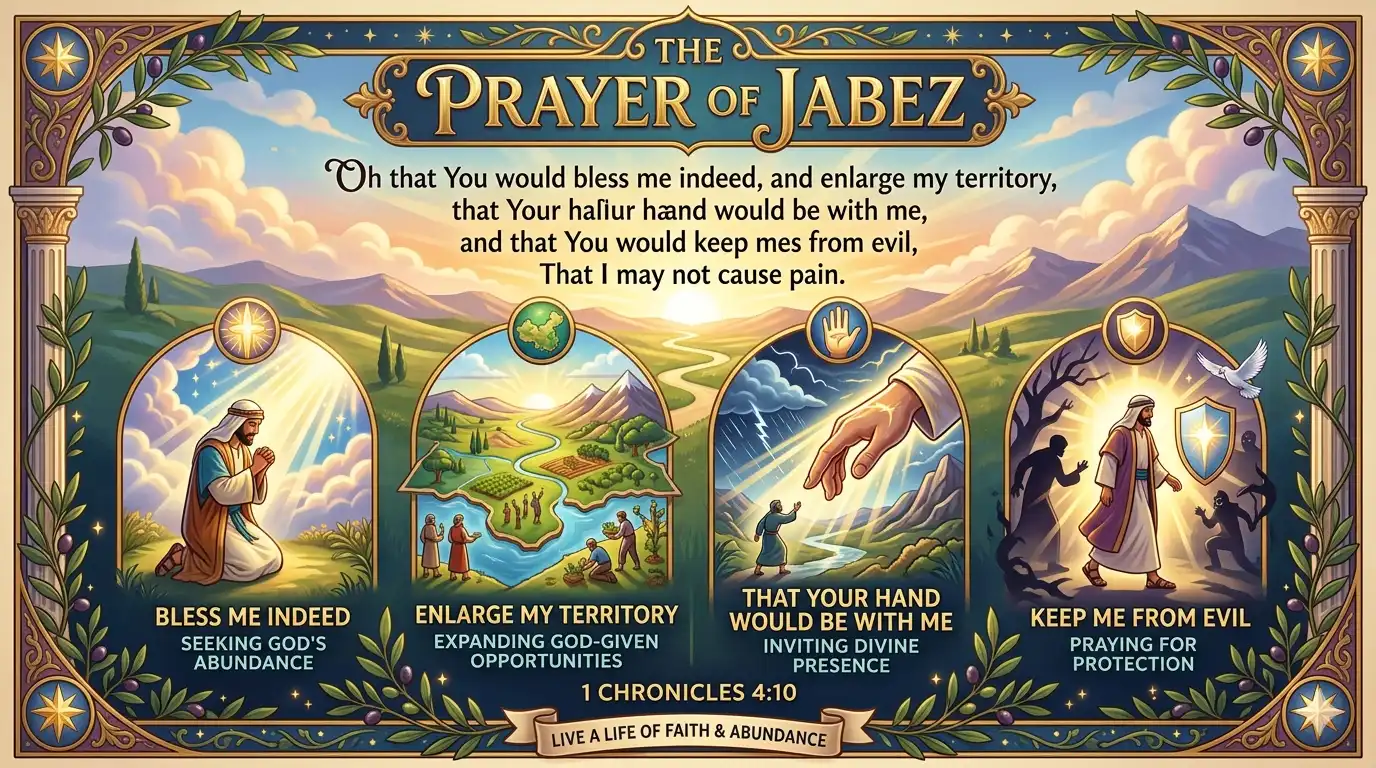
“Jabez cried out to the God of Israel, ‘Oh that You would bless me and enlarge my territory! Let Your hand be with me, and keep me from harm so that I will be free from pain.’ And God granted his request.”
That is the entire account — two verses, tucked inside nine chapters of genealogy. Yet this brief prayer has captivated Bible readers for centuries and inspired millions worldwide, most notably through Bruce Wilkinson’s 2000 bestselling book.
What makes this prayer so powerful is not its length. It is its depth. Each phrase carries specific theological weight that applies directly to modern life.
Who Was Jabez? Understanding His Story
A Name Loaded with Pain
In ancient Hebrew culture, names were not just labels. They were declarations. They carried prophetic weight and shaped how a community perceived — and sometimes treated — a person.
The name “Jabez” (יַעְבֵּץ) means he causes pain or born in sorrow. His own mother named him this because of the suffering she endured during his birth. From his very first breath, Jabez carried a curse embedded in his identity.
This is a key competitor gap: most articles explain the meaning of the name but fail to explain what that meant for his daily life. In that culture, a name like Jabez was socially crippling. It could affect inheritance, marriage prospects, and community standing.
Yet He Was “More Honorable”
Despite his painful beginning, Scripture notes that Jabez was “more honorable than his brothers” (1 Chronicles 4:9). The Hebrew word here suggests moral weight and spiritual seriousness. Jabez was set apart — not because of his pedigree, but because of his posture toward God.
His legacy was not built on achievements. It was built on a prayer.
The Four Parts of the Prayer of Jabez — Line by Line
H2: Part 1 — “Oh That You Would Bless Me”
Jabez begins by asking God directly for blessing. This is not a selfish request — it is a humble acknowledgment that all good things flow from God alone.
The Hebrew word for “bless” here is doubled — bless, bless me — which in biblical grammar signals deep sincerity and urgency. Jabez was not casually mentioning blessings on a checklist. He was crying out.
What this means for you: When you pray for God’s blessing, you are not demanding. You are declaring your dependence. Blessing, in the biblical sense, means flourishing in alignment with God’s purposes — spiritually, relationally, and in your sphere of influence.
H2: Part 2 — “Enlarge My Territory”
This is the most misunderstood line of the prayer.
Many people hear “enlarge my territory” and think of bigger houses, higher salaries, or career promotions. Competitors often leave this surface-level. Here is the deeper truth:
In Jabez’s historical context, territory represented responsibility and purpose. Land in ancient Israel was connected to calling — the ability to serve God’s people, raise families, and advance God’s covenant. To ask for enlarged territory was to say, “God, give me more capacity to do what You created me to do.”
Today, this translates to:
- Influence — More people you can serve and lead
- Ministry — A wider reach for gospel work
- Business — Expansion that funds kingdom purposes
- Relationships — A broader impact in your community
Crucially, if you ask God to enlarge your territory, you must be willing to move. You cannot stay comfortable and expect your borders to expand. Jabez’s prayer was a commitment, not just a request.
H2: Part 3 — “Let Your Hand Be With Me”
Jabez immediately follows his expansion request with a plea for God’s presence and power. This is theologically significant.
He did not ask for resources, talent, or connections. He asked for God’s hand — a biblical phrase representing divine strength, guidance, and sustaining power.
This is the prayer of a man who understood a dangerous truth: more territory brings more pressure. Expansion invites attack. Larger responsibility requires greater grace.
The Prayer of Jabez is not a prosperity prayer. It is a dependency prayer. Jabez wanted God’s power, not personal power. He said, in effect, “Do not send me out into this new territory alone.”
Modern application: Before you seek growth in any area of life, pray first for God’s presence to accompany it. Success without God’s sustaining hand leads to burnout. Expansion without divine guidance leads to disaster.
H2: Part 4 — “Keep Me From Harm So I Will Be Free From Pain”
Here, Jabez circles back to his name. His mother called him Pain. He refuses to let that name define his future.
This petition is a prayer for protection from evil, temptation, and destructive patterns. Some translations read “that it may not grieve me” or “that I may not cause pain” — a request that is both personal and communal. Jabez wanted to break the cycle, not just for himself, but so he would not pass sorrow on to others.
Jesus taught His disciples to pray, “Deliver us from the evil one” (Matthew 6:13). Jabez prayed the same heart centuries earlier.
The competitor gap here: Most articles treat this line as a simple “protect me from bad things” statement. But the deeper meaning is a request to break generational patterns — the pain you inherited from your past does not have to define your future.
Why God Answered Jabez’s Prayer
The final three words of 1 Chronicles 4:10 carry enormous weight: “And God granted his request.”
God answered because:
1. Jabez prayed with bold faith. He did not ask timidly. He cried out. Prayer that moves mountains is prayer that is earnest, specific, and persistent.
2. Jabez prayed within God’s will. He was not asking for selfish accumulation. He was asking to be useful — to enlarge his ability to serve God’s covenant purposes.
3. Jabez acknowledged the right source. He did not go to a king, a wealthy family member, or his own ingenuity. He went straight to the God of Israel.
Like Solomon’s prayer for wisdom (1 Kings 3:5-14), Jabez’s prayer was answered because it aligned with what God desires for His people — not comfort, but purpose.
How to Pray the Prayer of Jabez Today
Praying the Prayer of Jabez is not about memorizing a formula. It is about cultivating a posture. Here is a practical approach:
Find quiet space. Eliminate distractions. This prayer asks for transformation — treat it with the seriousness it deserves.
Pray with sincerity, not speed. Do not rush through the words. Sit with each line. Let each petition become personal.
Personalize it. Jabez prayed for his circumstances. Pray for yours. “Lord, enlarge my territory in my marriage… in my business… in my ministry…”
Pray consistently. This is not a once-done prayer. Many believers make it a daily practice — a morning reset of dependence on God.
Live it out. Prayer and action are partners. If you ask God to enlarge your territory, be ready to say yes when new doors open. If you ask for protection from evil, pursue holiness with intention.
Common Misconceptions About the Prayer of Jabez
Misconception 1: It Is a Prosperity Formula
Critics have rightly challenged interpretations that reduce this prayer to a “name it and claim it” formula. Wilkinson’s book was praised by many but also criticized for potentially encouraging a transactional view of God.
The Prayer of Jabez is not a vending machine prayer. God answers according to His will, not our wishes. Jabez’s request aligned with God’s purposes for His covenant people — and that is why it was granted.
Misconception 2: It Guarantees Material Success
Praying this prayer does not guarantee financial wealth, career advancement, or physical comfort. What it does invite is a deeper partnership with God in His purposes — and that often looks different than we expect.
Misconception 3: It Is Selfish
At first glance, Jabez uses “me” and “my” five times. But a personal prayer is not the same as a selfish prayer. Jabez was asking God to use him — not merely to pamper him. There is a difference between seeking blessing for yourself and seeking blessing through yourself.
FAQ: The Prayer of Jabez
Q: Where is the Prayer of Jabez found in the Bible? It is found in 1 Chronicles 4:9-10, embedded in the genealogical records of the tribe of Judah.
Q: Can anyone pray the Prayer of Jabez? Yes. The prayer is not restricted to any particular group. Anyone who approaches God in faith can pray it. However, the prayer is most meaningful within the context of a genuine relationship with God through Jesus Christ.
Q: Should I pray the Prayer of Jabez every day? Daily prayer deepens your relationship with God, but sincerity matters more than frequency. Pray it regularly, but always with genuine intention rather than as a ritual.
Q: Does the Prayer of Jabez guarantee success? No. It is not a formula for guaranteed outcomes. It is a prayer of surrender — inviting God to bless, guide, and protect according to His will, not ours.
Q: Is the Prayer of Jabez just for Christians? It originates from the Hebrew Scriptures and is relevant to all who believe in the God of Abraham, Isaac, and Jacob. For Christians, it carries additional depth when read through the lens of the New Testament.
Q: What does “enlarge my territory” really mean today? It means asking God to expand your influence, capacity, and impact — not for personal gain, but so you can serve more people and advance God’s purposes in your sphere of life.
Q: Why did God answer Jabez but not all prayers? God answers prayer according to His sovereign will and purposes. Jabez’s prayer aligned with God’s covenant intentions. God is not a formula — He is a person who responds to faith, sincerity, and prayers that honor His character.
Conclusion: The Prayer That Overcame a Name
Jabez was born in pain. His mother declared it. His name broadcast it. By every cultural expectation of his time, he was marked for sorrow.
But he refused to let a name define his destiny.
He prayed. He asked God to bless him, expand him, accompany him, and protect him. And God — the same God who hears your prayers today — granted his request.
The Prayer of Jabez teaches us that your beginning does not determine your ending. That God is not interested in your past labels. That a short, sincere, faith-filled prayer can rewrite the trajectory of a life.
You are not bound by the pain you were born into. You are not limited by the names others have given you. The God of Jabez is still listening.
Pray boldly. Live expectantly.
