The Story That Changed Everything
Sister Maria was 84 years old when she first told this story publicly.
She had survived a labor camp in Eastern Europe. For three years, she had no Bible, no rosary, no priest. One night, in total darkness, a woman next to her whispered a prayer she barely remembered from childhood. Line by line, they rebuilt it together from memory.
That prayer was the Hail Holy Queen.
“We wept when we reached the words ‘mourning and weeping in this valley of tears,'” Sister Maria later said. “Because we were not just saying the words. We were living them.”
That is the power of this prayer. It is not a formula. It is a cry from a real place, for real people in real pain — and it has been that cry for over a thousand years.
What Is the Hail Holy Queen Prayer?
The Hail Holy Queen — known in Latin as the Salve Regina — is one of the most beloved prayers in Catholic tradition. It is a Marian prayer, which means it is addressed to the Virgin Mary.
But it is not worship. It is a petition. It asks Mary to intercede — to bring our prayers to her Son, Jesus Christ.
The prayer belongs to a special group called the four Marian antiphons — official prayers of the Catholic Church sung at specific times of the liturgical year. The Hail Holy Queen is prayed from after Pentecost until the start of Advent.
Most Catholics encounter it at the end of the Rosary, where it has served as the closing prayer for centuries.
Hail Holy Queen Prayer — Full Text (English)
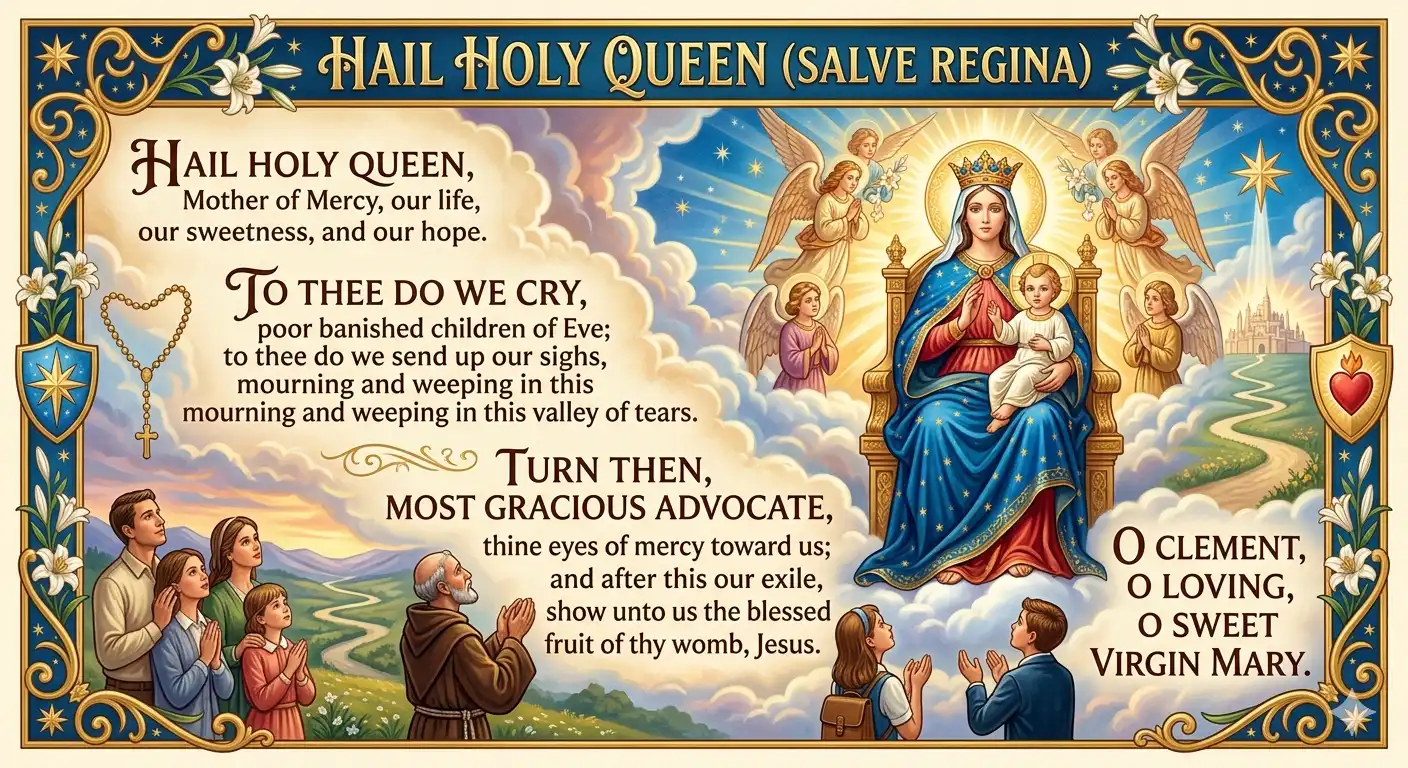
Hail, holy Queen, Mother of Mercy, our life, our sweetness and our hope. To thee do we cry, poor banished children of Eve. To thee do we send up our sighs, mourning and weeping in this valley of tears. Turn, then, most gracious advocate, thine eyes of mercy toward us, and after this, our exile, show unto us the blessed fruit of thy womb, Jesus. O clement, O loving, O sweet Virgin Mary.
V. Pray for us, O holy Mother of God. R. That we may be made worthy of the promises of Christ.
Closing Prayer (After the Rosary)
O God, whose only begotten Son, by His life, death, and resurrection, has purchased for us the rewards of eternal salvation. Grant, we beseech Thee, that meditating on these mysteries of the most holy Rosary of the Blessed Virgin Mary, we may imitate what they contain and obtain what they promise, through Christ our Lord. Amen.
Hail Holy Queen — Full Latin Text (Salve Regina)
Salve, Regina, Mater misericordiae; vita, dulcedo et spes nostra, salve. Ad te clamamus, exsules filii Hevae. Ad te suspiramus, gementes et flentes in hac lacrimarum valle. Eia ergo, Advocata nostra, illos tuos misericordes oculos ad nos converte. Et Jesum, benedictum fructum ventris tui, nobis post hoc exsilium ostende. O clemens, O pia, O dulcis Virgo Maria.
History and Origin of the Hail Holy Queen
The Hail Holy Queen dates back to around the 11th century. Its precise authorship is debated among historians and theologians.
The most widely cited candidate is Hermann of Reichenau (also called Hermanus Contractus), a German Benedictine monk and scholar. He was born with cerebral palsy, a cleft palate, and spina bifida. He could barely move or speak. And from that place of suffering, many believe he gave the world this prayer — words that would echo across a thousand years of human pain and hope.
Other candidates proposed include Adhémar de Monteil, Bishop of Le Puy, and even Pope Gregory II.
What is certain: by the 11th century, the prayer was in widespread use. The Dominicans formally adopted it as a close to the Divine Office in 1221. Pope Pius V incorporated it officially into the Rosary in 1568.
St. Alphonsus Liguori, the great 18th-century theologian, valued this prayer so highly that he dedicated an entire chapter to analyzing it line by line in his celebrated book The Glories of Mary.
Line-by-Line Meaning of the Hail Holy Queen
Understanding each phrase transforms the prayer from words into a living conversation.
“Hail, holy Queen, Mother of Mercy”
We begin with a greeting and three titles. “Hail” mirrors the angel Gabriel’s greeting to Mary at the Annunciation. “Holy Queen” reflects Mary’s role as Queen of Heaven — because her Son is the King of Heaven and earth. “Mother of Mercy” is the most tender title: she is the one who brings God’s mercy close to us.
“Our life, our sweetness, and our hope”
These words do not replace Christ. They describe what Mary is to us on the journey toward Christ. She is “our life” because she leads us to the Source of all life. She is “our sweetness” in a world full of bitterness, She is “our hope” when despair tries to close in.
“To thee do we cry, poor banished children of Eve”
This line names the truth of the human condition honestly. After original sin, we inherited a fallen nature. “Poor” means we cannot save ourselves. “Banished” means we live outside Eden, away from our original closeness with God. The prayer does not say this to crush us — it says it so we can stand honestly before God and ask for help.
“Mourning and weeping in this valley of tears”
Life carries real suffering. Loss, loneliness, grief, illness, failure. The prayer names this valley without sugarcoating it. It validates human pain. And in naming it, it opens the door to bringing that pain to Mary.
“Turn, then, most gracious advocate, thine eyes of mercy toward us”
Mary is called our “advocate” — one who pleads on our behalf. She turns her merciful eyes toward us. The image is personal and maternal: a mother looking at a struggling child with total compassion, not judgment.
“After this, our exile, show unto us the blessed fruit of thy womb, Jesus”
“This exile” is our earthly life — our time away from our eternal home. The prayer’s great hope is this: when the exile ends, Mary will bring us to Jesus face to face. He is the destination. Mary is the one who leads us there.
“O clement, O loving, O sweet Virgin Mary”
The prayer ends with three soft, intimate words: clement (merciful), loving, sweet. It is a whisper of trust. It closes not with formal theology but with a child calling out to a mother.
When to Pray the Hail Holy Queen
The Hail Holy Queen is prayed in several specific contexts in Catholic life:
At the end of the Rosary — This is where most Catholics pray it. After the fifth decade, the Hail Holy Queen closes the entire meditation and entrusts all the mysteries to Mary.
At night prayer (Compline) — From after Pentecost until Advent, the Church traditionally sings the Salve Regina at the close of the day. Monks and religious communities have done this for centuries.
During Marian devotions and processions — It is sung at Benediction of the Blessed Sacrament and in Marian feast celebrations.
In times of personal trial — For those who struggle with grief, illness, or fear, this prayer becomes a simple but powerful reach toward Mary’s intercession.
At priestly funerals — It is traditionally sung by fellow clergy at the funeral of a priest.
Before confession — It is fitting to ask Mary’s help before approaching the Sacrament of Reconciliation.
The Hail Holy Queen in the Rosary: Where It Fits
After completing all five decades of the Rosary, Catholics pray:
- The Hail Holy Queen
- The Versicle and Response (“Pray for us, O holy Mother of God…” / “That we may be made worthy…”)
- The closing Rosary prayer (“O God, whose only begotten Son…”)
- Optional prayers: the Fatima Prayer, Litany of Loreto, etc.
Pope Pius V officially standardized this placement in 1568, though informal use of the prayer after the Rosary predates that by several centuries.
The theological meaning of this placement is significant. The Rosary takes us through the key events of salvation history — from the Annunciation to the Resurrection. After contemplating these sacred mysteries, we acknowledge that we still live in this “valley of tears” and need Mary’s continued intercession to reach what those mysteries promise.
Hail Holy Queen vs. Hail Mary — What Is the Difference?
Many people wonder how these two famous Marian prayers differ.
The Hail Mary is a short greeting drawn from Scripture. It begins with the Angel Gabriel’s words (Luke 1:28), continues with Elizabeth’s words (Luke 1:42), and closes with a petition.
The Hail Holy Queen is a longer, more poetic prayer of petition. It was composed in the Middle Ages — not drawn from Scripture — and focuses on our earthly struggles and hope for heaven. While the Hail Mary is intimate and personal, the Hail Holy Queen is more like a formal address to a queen, from people who know they need her help.
Both belong to the Rosary. The Hail Mary is prayed throughout — ten times per decade. The Hail Holy Queen comes once, at the very end, as a closing act of trust.
Common Misconceptions About This Prayer
“Aren’t Catholics worshipping Mary?” No. The prayer is a petition, not worship. It asks Mary to intercede with her Son. This is no different from asking a holy person to pray for you — except that Catholics believe Mary, now in heaven, has unique closeness to Christ. All worship in Catholic prayer is directed to God alone.
“Does Mary replace Jesus?” The prayer explicitly directs our hope toward Jesus. The final petition asks Mary to “show unto us the blessed fruit of thy womb, Jesus.” The destination is always Christ. Mary points the way.
“Is this prayer in the Bible?” The prayer itself is not in Scripture, though its theology is rooted in Scripture (Luke 1:28, 1:42, Rev 12:1). The Catholic Church has always held that valid prayers may develop from within Tradition, not only from Scripture alone.
FAQ: Hail Holy Queen Prayer
What does “Salve Regina” mean? Salve Regina is Latin for “Hail, Queen.” It is the original title of the prayer and the opening words of the Latin version.
Who wrote the Hail Holy Queen? The exact author is unknown. Most historians attribute it to Hermann of Reichenau, an 11th-century German monk. Other proposed authors include Adhémar de Monteil and Pope Gregory II.
When is the Hail Holy Queen prayed in the liturgy? It is prayed from the end of Eastertide (after Pentecost) until the beginning of Advent, traditionally at night prayer (Compline). It also closes every full Rosary.
Is the Hail Holy Queen a required prayer? For the official Liturgy of the Hours, yes — it is one of four mandatory Marian antiphons prayed at the prescribed seasons. For the Rosary, it is the traditional closing prayer.
Can non-Catholics pray the Hail Holy Queen? There is no restriction. Anyone seeking Mary’s intercession may pray it. However, it reflects Catholic theology about Mary’s role as advocate and Queen of Heaven.
What is the “valley of tears”? It refers to earthly life — the suffering, grief, and hardship we experience in this world before reaching our eternal home with God.
Why does the prayer call us “banished children of Eve”? This phrase refers to the doctrine of original sin. Through Adam and Eve, humanity lost its first friendship with God and its original home in paradise. We are “banished” from Eden, living in exile until we return to God.
How long does it take to pray the Hail Holy Queen? About 30 to 60 seconds when prayed at a thoughtful pace.
Why This Prayer Has Lasted 1,000 Years
Prayers come and go. Devotions rise and fade. But the Hail Holy Queen has remained for over a millennium — in monasteries, in prisons, at deathbeds, in wars, in living rooms at night.
The reason is simple.
It is honest, It does not pretend life is easy, It walks into the valley of tears with us, names what is real, and then lifts our eyes to something beyond it,
It is personal. Mary is not addressed as a distant theological concept but as a mother — clement, loving, sweet.
And it carries a promise. After this exile. After this valley. There is a showing. Mary will show us Jesus. That is the hope the prayer points toward. Not escape from suffering, but the One who stands on the other side of it.
Sister Maria whispered it in a labor camp with nothing but memory and faith. Monks have sung it as the day ends and the darkness comes. Mothers have prayed it at the bedsides of dying children.
The words are simple. The meaning is deep. The prayer endures.
Conclusion
The Hail Holy Queen prayer is one of the great treasures of Catholic spiritual life. For over a thousand years, it has given believers a way to bring their grief, their exile, and their hope directly to the Mother of Mercy — and through her, to her Son.
Whether you are new to this prayer or have prayed it for decades, understanding its history and meaning can transform it from a habit into a heartfelt act of faith.
Pray it slowly. Let the words mean something. And trust that when you cry out from your own valley of tears, you are joining a chorus that has never stopped — across centuries, across languages, across every kind of human suffering — always rising toward the same horizon.
