When darkness falls and the daily noise subsides, many people struggle to quiet their racing minds. You might lie awake replaying stressful conversations, worrying about tomorrow, or seeking inner stillness. For thousands of years, believers have turned to the ancient tradition of Hebrew night prayer to surrender their heavy burdens before falling asleep.
Rooted deeply in Sacred Scripture, these evening petitions offer a sanctuary for the weary soul. By speaking words that faithful believers have prayed for centuries, you anchor your heart in God’s eternal presence. In this guide, we will explore the rich history of evening devotion, examine its biblical roots, and share meaningful prayers you can pray tonight.
Table of Contents
- What Is the Traditional Bedtime Shema?
- The Core Elements of a Traditional Hebrew Night Prayer
- Hashkiveinu: Resting Beneath God’s Canopy of Peace
- A Hebrew Night Prayer for Peace and Protection
- A Personal Reflection: Quiet in the Middle of the Storm
- Ancient Biblical Scriptures to Pray Before Sleep
- How to Establish an Evening Prayer Routine
- Frequently Asked Questions About Hebrew Night Prayers
What Is the Traditional Bedtime Shema?
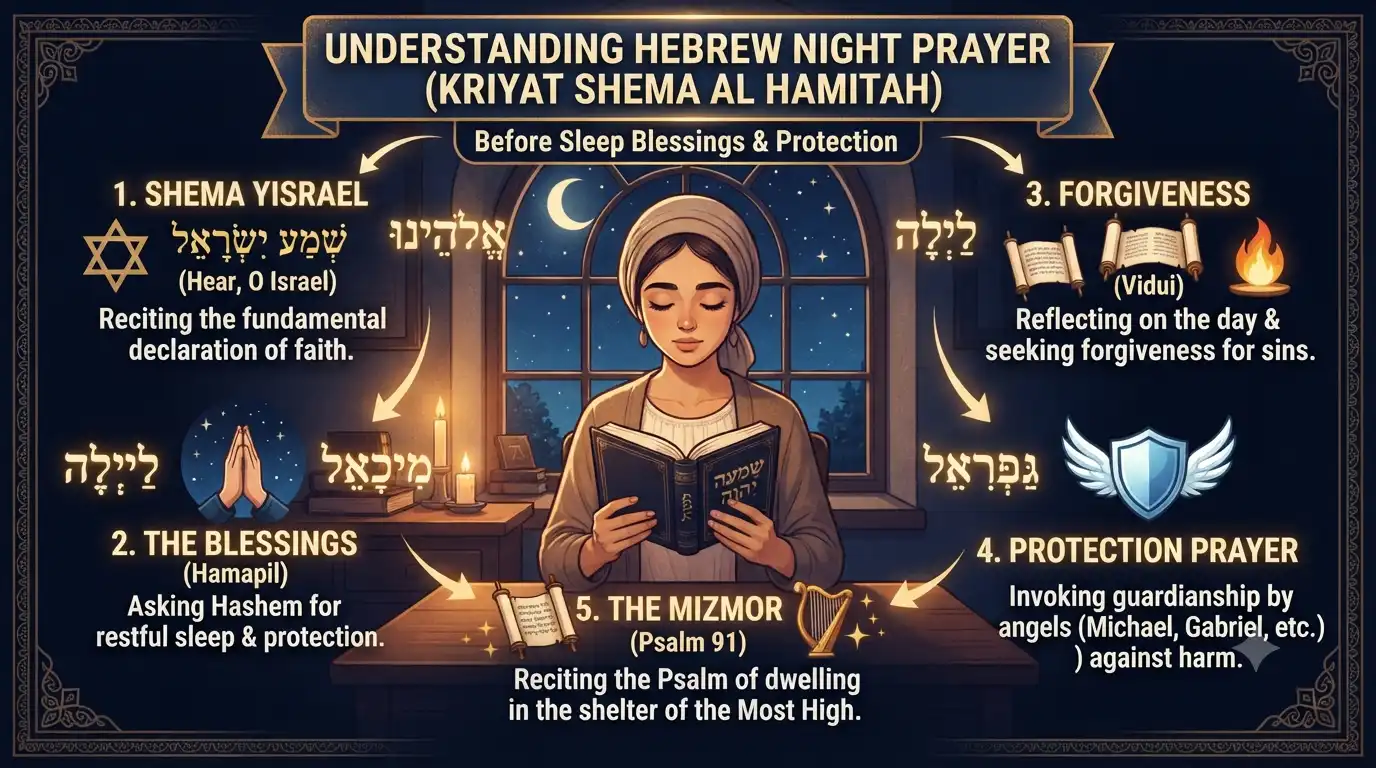
In Jewish tradition, evening prayer before sleep is known as Kriat Shema al HaMitah, or the Bedtime Shema. This practice is built around the fundamental declaration of faith found in Deuteronomy 6:4-9.
Ancient sages understood that nighttime can feel uncertain or scary. Because sleep is a vulnerable state, turning to God as protector brings deep comfort. Therefore, the traditional Hebrew night prayer blends worship, forgiveness, and requests for safety.
By praying before sleep, you deliberately transition from daily effort into divine trust. You acknowledge that while you rest, the God of Israel remains active and vigilant.
“Hear, O Israel: The LORD our God, the LORD is one. You shall love the LORD your God with all your heart and with all your soul and with all your might.”
— Deuteronomy 6:4–5
The Core Elements of a Traditional Hebrew Night Prayer
While evening traditions vary, a full Hebrew night prayer usually includes four central pillars. Understanding these elements helps you pray with deeper intent and spiritual awareness.
- The Blessing of Sleep (Hamapil): A prayer praising God who brings sleep to the eyes and restores the body.
- The Declaration (Shema): Reciting God’s oneness and committing your heart entirely to Him.
- Request for Protection (Hashkiveinu): Asking God to spread a canopy of peace over your home.
- Surrender of the Spirit (B’yado Afkid Ruchi): Placing your soul into God’s faithful hands as you sleep.
Each section addresses a specific human emotion. For example, Hamapil acknowledges physical tiredness, while Hashkiveinu addresses emotional anxiety. Together, these petitions create a complete shield of peaceful devotion.
Hashkiveinu: Resting Beneath God’s Canopy of Peace
One of the most moving parts of evening devotion is the Hashkiveinu prayer. The word Hashkiveinu literally means “Cause us to lie down.”
This prayer asks God to guard our coming and going, distance us from harm, and grant us calm sleep. In ancient times, night carried danger from wild animals and enemies. Today, our dangers often look like anxiety, burnout, or sleeplessness.
When you pray this theme, you ask God to stretch His Sukkat Shalom—His canopy of peace—over your bedroom. Consequently, your room becomes a place of refuge where worries cannot control you.
A Prayer for Divine Shelter
Adonai, my God, guide me into peaceful sleep tonight. Please spread Your umbrella of peace over my mind and home. Remove worry, darkness, and fear far from my room. Guard my life while I rest, and restore my body to wakefulness tomorrow. Amen.
A Hebrew Night Prayer for Peace and Protection
If you want to incorporate Hebrew phrasing into your evening routine, you do not need to speak fluent Hebrew. Simply understanding key terms enriches your connection to God.
Here is a heartfelt Hebrew night prayer that combines English petitions with traditional Hebrew expressions of faith:
Evening Prayer of Entrustment
Baruch Atah Adonai, Blessed are You, Lord my God, King of the universe.
You bring sleep to my eyes and quiet to my weary soul.
Tonight, I lean upon Your promise as the Guardian of Israel who neither slumbers nor sleeps.
Into Your hand I commit my spirit—B’yado afkid ruchi.
Shield my home from fear, steady my heart, and let Your peace rest upon me.
In the holy name of my Redeemer, Amen.
A Personal Reflection: Quiet in the Middle of the Storm
A few winters ago, my daughter developed a sudden high fever in the middle of the night. As the wind rattled our bedroom windows, panic started to grip my heart. I sat beside her bed in the dark room, feeling helpless as I watched her fever rise.
In that moment of vulnerability, I remembered the ancient Hebrew phrase from Psalm 31:5: B’yado afkid ruchi—”Into Your hand I commit my spirit.”
Instead of letting anxiety spiral, I whispered those four words over and over. Slowly, a profound quiet replaced my terror. I realized that my child was held in hands far stronger than mine. Her fever eventually broke before dawn, but the lesson stayed with me forever.
When we release control through a Hebrew night prayer, we replace our fragile worries with God’s unfailing strength.
Ancient Biblical Scriptures to Pray Before Sleep
Scripture is the ultimate foundation for effective prayer. Incorporating specific verses into your nighttime routine helps fill your mind with divine truth instead of daily distractions.
1. Psalm 31:5
“Into your hand I commit my spirit; you have redeemed me, O LORD, faithful God.”
This verse was prayed by Jesus on the cross (Luke 23:46). It represents total trust and peaceful surrender before closing your eyes.
2. Psalm 91:1–2
“He who dwells in the shelter of the Most High will abide in the shadow of the Almighty. I will say to the LORD, ‘My refuge and my fortress, my God, in whom I trust.'”
In Hebrew tradition, Psalm 91 is known as the song of protection. Reading this psalm aloud builds a mental wall against nighttime anxiety.
3. Psalm 4:8
“In peace I will both lie down and sleep; for you alone, O LORD, make me dwell in safety.”
This brief verse acts as a peaceful blessing. Recite it as you physically lie down on your pillow.
How to Establish an Evening Prayer Routine
Creating a bedtime prayer ritual does not require complex preparation. In fact, consistency and simplicity are key to developing a lasting habit.
[ Disconnect ]
Turn off digital screens 30 mins before bed.
│
▼
[ Light & Quiet ]
Dim the lights and sit in comfortable stillness.
│
▼
[ Scripture ]
Read a psalm or short passage slowly.
│
▼
[ Prayer ]
Offer a simple Hebrew night prayer of trust.
First, eliminate digital screens at least thirty minutes before sleeping. Bright lights and rapid content keep your brain on high alert.
Second, sit in quiet stillness for two minutes. Acknowledge God’s presence in your bedroom before speaking a single word.
Third, read a single scripture passage, such as Psalm 91 or Deuteronomy 6:4–5. Reflect on God’s character and goodness.
Finally, speak your prayer. Forgive anyone who hurt you during the day, release your unresolved tasks, and drift off to sleep trusting God.
Closing Reflection: Resting in Unfailing Hands
Nighttime should not be a season of dread or restless thoughts. Instead, it is a daily gift designed for physical recovery and spiritual renewal.
When you pray a Hebrew night prayer, you join a continuous chain of believers stretching across thousands of years. You remind your soul that God rules over the darkness just as sovereignly as He rules over the daylight.
Tonight, let go of the burdens you were never meant to carry alone. Place your life, your family, and your morning into the hands of the Lord who guards you faithfully.
Frequently Asked Questions About Hebrew Night Prayers
What is the name of the Hebrew night prayer?
The main Jewish bedtime prayer sequence is called the Bedtime Shema (Kriat Shema al HaMitah). It includes the Shema declaration, the Hamapil blessing for sleep, and the Hashkiveinu petition for protection.
Why do people recite the Shema before sleeping?
Reciting the Shema before sleep reaffirms a believer’s love for God at the end of the day. Because sleep resembles a temporary surrender of consciousness, ending the day with God’s name on your lips brings ultimate spiritual safety.
What does “B’yado Afkid Ruchi” mean?
This phrase comes from Psalm 31:5 and means “Into His hand I commit my spirit.” It is a traditional Hebrew evening phrase used to surrender one’s soul into God’s care before going to sleep.
Can Christians pray Hebrew night prayers?
Yes, absolutely. Jesus and His early followers prayed Hebrew scriptures and evening petitions. Praying these ancient words connects Christian believers with the rich biblical roots of their faith.
